Firearms
Lead-Free Load Data for Vintage Guns: What Pressures Your Old Lever-Action Can Actually Handle
By Staff · June 27, 2026
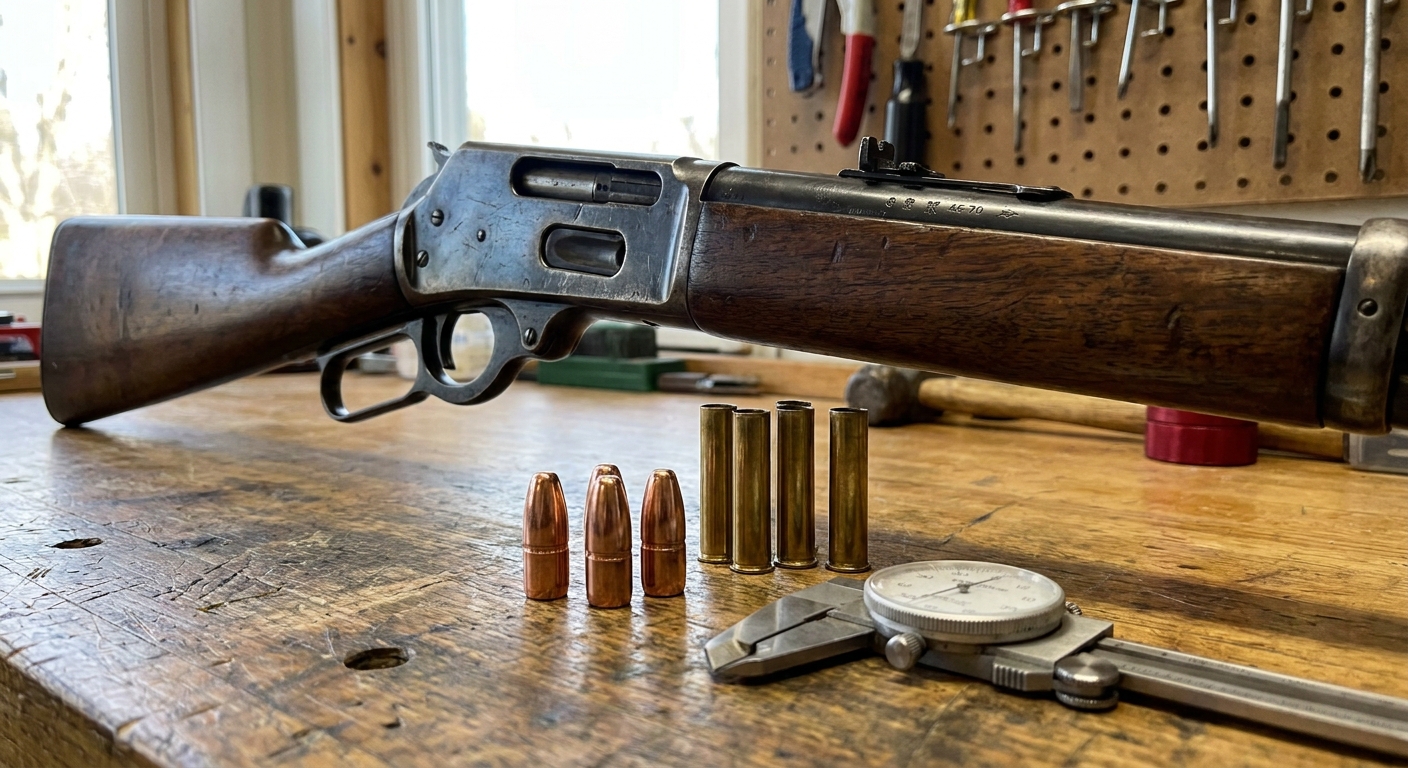
Your grandfather's lever-action still locks up tight and shoots straight. The problem is what you're allowed to feed it. Wildlife regulators now ban the lead ammunition your gun was designed around, but nobody published pressure data for running copper bullets through seventy-year-old steel that can't be replaced if you guess wrong.
Since 1991, federal law has prohibited hunting waterfowl with lead shot nationwide. Some states have expanded bans to all hunting. This forces owners of vintage firearms into an impossible choice: retire mechanically sound family guns to the safe, risk damaging irreplaceable heirlooms with incompatible modern loads, or hunt illegally. The manufacturers who built your pre-war double or lever-action in.45-70 never published data for copper bullets or bismuth shot because those materials didn't exist as hunting ammunition. Modern ammunition companies optimize loads for contemporary metallurgy and proof standards, not for your grandfather's rifle.
The uncertainty centers on whether modern lead-free projectiles—copper bullets and bismuth or steel shot—will generate safe pressure curves and compatible barrel interactions in firearms designed decades before these materials entered the market. This technical path forward allows informed stewardship decisions based on pressure specs, barrel metallurgy, and material compatibility rather than guesswork or premature retirement of working firearms.
The Material Science Problem
Modern lead-free projectiles behave fundamentally differently than the lead bullets your vintage gun was designed to shoot. Lead has a density of approximately 11.34 g/cm³. Copper sits at 8.93 g/cm³, bismuth at 9.78 g/cm³, and steel at only 7.85 g/cm³.
Because copper bullets are less dense than lead, they must be longer for the same weight, which increases bearing surface against the barrel and affects both stabilization requirements and friction during firing. Copper bullets often require higher velocities to deliver equivalent downrange energy, which can influence chamber pressure depending on load design, powder selection, and bullet construction. Your vintage action doesn't care about the regulatory intent behind these new materials. It only responds to the mechanical reality of what you chamber into it.
The SAAMI Standard Nobody Wrote for Your Gun
SAAMI assigns a single maximum average pressure to each caliber regardless of the specific firearm used—for example,.45-70 Government is standardized at 28,000 psi or 28,000 CUP. But loading manuals recognize what regulators don't: not every.45-70 rifle was built to the same strength.
Loading manuals distinguish three pressure levels for calibers like.45-70: Trapdoor level at approximately 20,000–21,000 CUP for the 1873 Trapdoor Springfield, Standard SAAMI level at 28,000 CUP safe for vintage lever-actions built for smokeless powder, and Strong/Modern level at 40,000–50,000 CUP safe only in modern reinforced actions.
Your pre-war lever-action sits in the middle category—capable of handling full SAAMI-standard ammunition but absolutely not the hot modern loads that current manufacturers build their rifles to digest. Ammunition manufacturers have no commercial incentive to develop vintage-specific copper bullet loads for a shrinking market of pre-war rifles.
Reading the Metal
The proof marks stamped into your vintage shotgun or rifle represent a promise made decades ago about what pressures the metal could withstand. But only if you can read them.
Proof marks on European vintage firearms indicate the gun underwent pressure testing to verify safe handling of overcharged ammunition, with marks revealing the maker's country and specific proof house where testing occurred. European CIP proof testing requires 25% over nominal rating with two firings, while American SAAMI recommendations call for 33–44% over nominal rating with a single firing, though U.S. manufacturers conduct testing at discretion rather than under mandate. Proofing is a pass-or-fail test: if the gun withstands an overloaded round, it is guaranteed to safely handle standard factory ammunition at rated pressures.
Critically, proof marks can determine whether a gun was proofed with black powder or modern smokeless powder, helping date the firearm and verify safety for rated pressures. If your gun carries only black powder proof marks, you're already operating outside its tested envelope with any smokeless load, lead-free or otherwise.
What Steel You're Actually Working With
The barrel steel itself determines whether modern pressures will work or create a catastrophic failure. Manufacturers rarely stamped metallurgical specifications where you can see them.
Pre-1895 black powder era barrels used standard carbon steel sufficient for lower pressures, while post-1895 smokeless powder firearms used Nickel Steel, an alloy containing nickel and often chromium or manganese for enhanced strength and ductility. For vintage pre-war lever-actions like the Winchester Model 1886, barrel steel was primarily carbon steel for black-powder cartridges, with Nickel Steel introduced for high-pressure smokeless or high-velocity cartridges starting around 1895.
If a vintage rifle is marked Nickel Steel, it was specifically ordered for smokeless powder loads, though a rifle without the marking could still have a Nickel Steel barrel if the buyer requested it. You're reading tea leaves in metal, trying to determine what a long-dead buyer specified and what a long-closed factory delivered.
Modern reproduction lever-action barrels use 4140 alloy steel or 416R stainless steel, providing reference points for understanding vintage steel capabilities. Action type adds another variable: toggle-lock lever-actions versus sliding-bolt pump-actions versus break-action doubles each offer different mechanical advantages and stress distribution.
How Copper and Bismuth Actually Behave
The material interaction between modern projectiles and vintage steel creates pressure dynamics the original designers never had to consider.
Copper bullets expand as well as or better than lead core bullets in most calibers, with a stable expansion index around 2.6, and they retain mass without fragmenting. The hardness interaction between copper projectiles and vintage barrel steel—particularly softer carbon steel versus harder Nickel Steel—determines whether engraving resistance and friction will stay within safe parameters or generate excessive pressure spikes.
Bismuth shot offers better news for vintage shotgun owners. Bismuth is as soft as lead and patterns similarly, with penetration nearly equal—pheasant tests showed bismuth achieving 4.12 inches versus lead's 3.86 inches average. Bismuth patterns slightly more open than lead, so a tighter choke is recommended to compensate.
Steel shot represents the opposite extreme. Its significantly lower density and greater hardness create unique challenges in vintage shotguns, particularly with fixed chokes, as the hardness mismatch can damage choke constrictions designed for soft lead deformation. Steel does not deform through the choke like lead, creating backpressure. Damascus barrels—formed by welding twisted steel and iron strips—present a categorical incompatibility with steel shot and high-pressure loads due to the layered construction's vulnerability to stress concentration.
What the Ammunition Industry Won't Tell You
The ammunition industry offers limited help because vintage-specific loads represent a niche market with liability concerns. Factory ammunition marketed as "reduced recoil" or "cowboy action" equivalents in lead-free formulations typically operates at the lower end of SAAMI pressure ranges, making them natural candidates for vintage firearms—when you can find them.
For calibers like.45-70, shooters with vintage lever-actions should strictly adhere to the SAAMI standard of 28,000 CUP/psi, avoiding loads marked for strong or modern actions that reach 40,000–50,000 CUP. Velocity bands serve as practical pressure indicators: Trapdoor-level loads typically reach 1,200–1,400 fps, Standard SAAMI loads 1,600–1,800 fps, and Modern loads exceed 2,000 fps. For shotshells, bismuth loads engineered to maintain safe operating pressures use optimized powders and shell designs to maximize velocity within constraints suitable for older actions.
Handloaders should start with published load data explicitly rated for vintage firearms, reducing maximum charges by 10% as a starting point and working up gradually while monitoring pressure signs. Federal game agents can inspect waterfowl hunters in the field to verify ammunition compliance, requiring ammunition to be electronically tested and approved by USFWS. Getting caught with the wrong ammunition costs you. Getting it wrong in the chamber could cost you the gun.
Warning Signs You're Pushing Too Hard
The warning signs of overpressure are your only real-time feedback that a load is exceeding your vintage action's design envelope.
Case head expansion—measured with calipers before and after firing—provides objective evidence of excessive chamber pressure, with growth beyond 0.001 inches signaling dangerous levels. Primer cratering, flattening, or piercing indicates pressure spikes, with primers flowing into the firing pin hole or exhibiting pancake flatness rather than slight rounding serving as clear warnings. Extraction issues—sticky bolt lift, heavy extraction effort, or ejector marks on case rims—signal that pressures are stressing the action beyond design parameters.
Copper fouling patterns differ from lead fouling, appearing as streaky blue-green deposits rather than gray smears, requiring different cleaning protocols but not necessarily indicating problems unless accompanied by accuracy degradation. In shotguns, patterns that suddenly open up, erratic point-of-impact shifts, or wad component failures can indicate pressure or material compatibility problems before mechanical damage occurs.
A graduated testing approach begins with the most conservative loads available, firing small sample groups while inspecting cases, primers, and extraction characteristics after each string before progressing. Testing should stop immediately upon any pressure sign—not because one indicator guarantees failure but because vintage firearms deserve conservative thresholds that preserve irreplaceable metal for future generations.
When Retirement Is the Right Answer
Some vintage firearms simply cannot make the transition to lead-free ammunition without unacceptable risk. Recognizing genuine limitations is part of informed stewardship.
Damascus barrels cannot safely handle stress concentrations from hard projectiles or elevated pressures. Pre-1895 black powder carbon steel barrels may lack the metallurgical properties to safely handle even SAAMI-standard smokeless pressures with modern projectiles, particularly if proof marks indicate black powder testing only. Fixed full chokes in vintage shotguns often cannot safely accommodate steel shot due to excessive constriction creating dangerous backpressure, even when chamber pressures remain within spec.
But retirement doesn't have to be total. Retiring a vintage shotgun from waterfowl duty while keeping it active for upland birds with bismuth or lead (where legal) preserves the firearm's working life without compromising safety. The federal waterfowl lead ban applies only to waterfowl, with lead shot remaining legal for deer and upland birds in most states unless state law expands prohibitions. Bismuth—which bridges the density gap between lead and steel and patterns like lead—offers a path for many vintage shotguns that cannot handle steel but can safely run softer non-toxic alternatives.
The Knowledge You Need Exists
What's missing is the institutional support to deliver it to vintage gun owners facing regulatory pressure.
Many vintage lever-actions with Nickel Steel barrels, pre-war pumps proofed for smokeless, and quality doubles with fluid steel barrels can safely run bismuth shot or moderate-pressure copper bullets when loads are matched to specifications. Bringing these firearms into the lead-free era is not risky experimentation but responsible stewardship—applying the same careful attention to pressure, materials, and mechanical limits that has always characterized thoughtful gun ownership.
The gun your grandfather carried didn't survive this long by accident. It endured because someone understood its limits and respected them. Lead-free regulations change what you can feed it, not what the metal can handle. Learn the pressure ceiling stamped into that steel decades ago, match modern loads to old tolerances, and the same gun that took deer generations ago will take deer today. The technical problems have solutions. Know what your gun can handle, and you'll know whether it still belongs in the field or finally earned its rest.