Guides
Bore Scoping on a Budget: How to Read What the Rifling Is Really Telling You Before You Buy or Shoot
By Staff · July 4, 2026
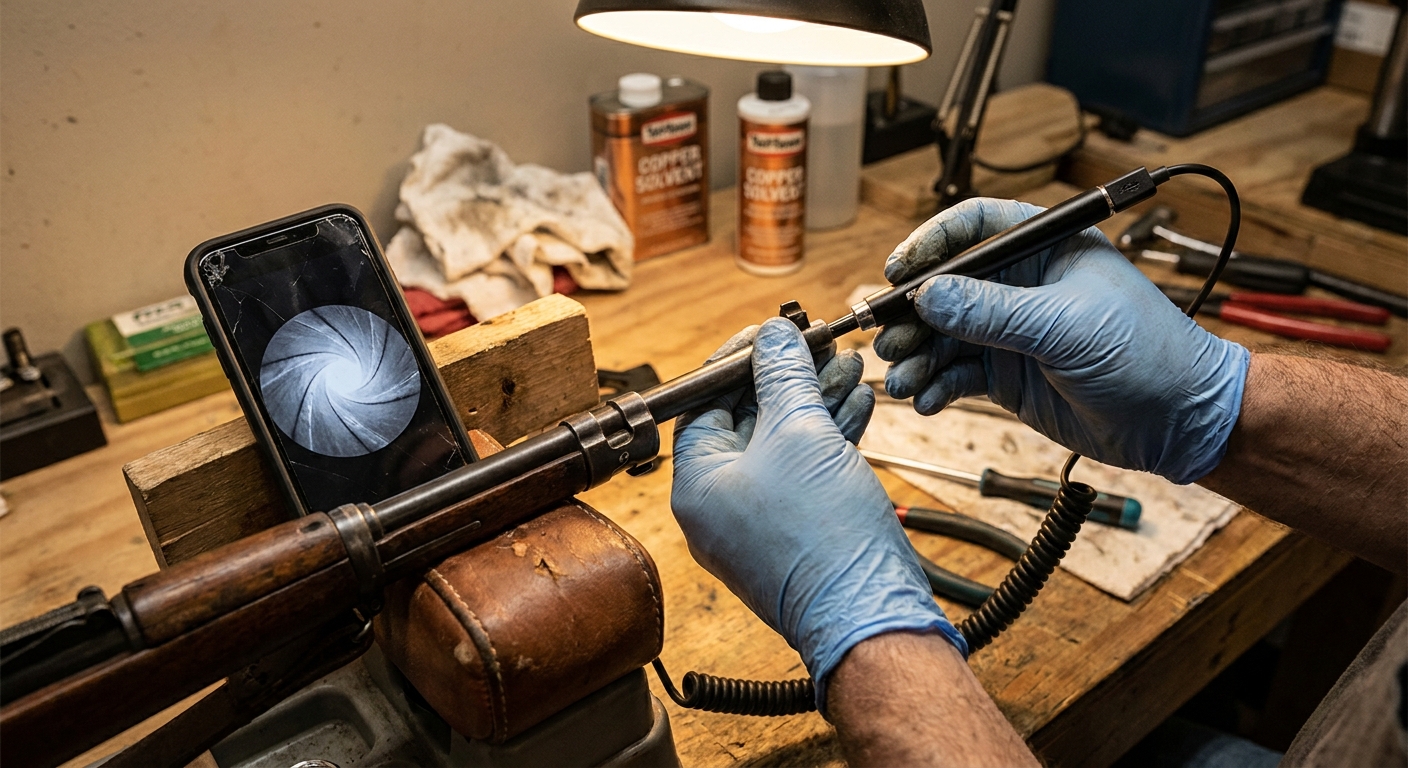
For generations, evaluating a used rifle barrel meant squinting down the bore with a flashlight, seeing mostly shadows and your own reflection, and placing your bet on gut feeling or the seller's word. The traditional advice—lock the action open, shine a light into the ejection port while looking down the muzzle—reveals general cleanliness but cannot show you the throat erosion, fire-cracking, or pitting where barrels actually fail. This asymmetry of information has always favored the seller. They know whether Grandpa's.30-06 was shot hard or stored wet. You're making a hundred-dollar decision in dim light with no real evidence.
USB borescopes for firearm barrel inspection are now available starting at approximately $12.82, with capable dual-lens models in the $20–40 range. Budget models like the Depstech 86T offer workshop-friendly durability for under $30, while professional articulating probe versions from manufacturers like Teslong run $119.99. This article is not about buying another gadget—it's about acquiring the diagnostic craft knowledge to read what your barrel is actually telling you.
To use a USB borescope, charge the device fully, connect it to your phone or laptop via USB, open the compatible app, and slowly insert the probe into the barrel while viewing the live feed. Adjust the inline dial on the cable to control LED brightness, and use the focus ring if the image appears blurry. What you're looking for is evidence of serviceability—the difference between a barrel that still has work left in it and one that's been exhausted.
Sharp rifling grooves in good condition show clear, raised edges called lands and deep recesses called grooves, without rounding or flattening. A healthy bore surface appears bright, shiny, and smooth with no rust, pits, or carbon rings—this reflective quality is the bright ring that indicates remaining barrel life.
Copper fouling appears as bluish-green or shiny metallic deposits left by the bullet jacket. Powder fouling appears as dark, sooty carbon deposits from unburned or partially burned powder, distinct from the metallic sheen of copper. Pitting appears as small craters or potholes in the steel surface, while surface rust shows as rough, textured discoloration that sits on top of the metal rather than excavating it. Learning to distinguish these features—metallic versus carbon deposits, surface texture versus deep damage, cleanable fouling versus permanent metal loss—is the foundation of informed barrel inspection.
The throat—the section of barrel just ahead of the chamber where the rifling begins—is where virtually all meaningful barrel wear starts and where your inspection should focus first.
Barrel throat erosion is caused primarily by extreme high-temperature gas expansion and microscopic metal tearing under pressure, not by friction from the bullet itself. Burning powder creates a high-temperature plasma that cuts the steel surface, turning metal atoms into plasma expelled with the bullet and physically reducing the steel mass. Repeated expansion and contraction cause microscopic cracks—called fire-cracking—visible through a borescope as a network of fine lines like crackled glass. When these cracks converge, tiny metal fragments break loose and are expelled with the gas, progressively eroding the throat and advancing the origin point of the rifling forward.
A throat gauge inserted through the action with the bolt removed measures the distance from bolt face to rifling origin; advancement of 0.040–0.060 inches indicates significant wear for standard cartridges, and 0.080–0.120 inches for magnums. Uniform erosion suggests consistent loads and proper care, while asymmetrical erosion indicates improper bedding, scope mounting issues, or corrosive ammunition. A throat showing minimal fire-cracking and sharp rifling edges tells you the rifle has been shot lightly or maintained carefully; heavy cracking and rounded lands reveal a barrel driven hard with hot loads or high round counts.
Pitting is the single most common deal-breaker in used firearms, but the critical distinction is between surface pitting that affects appearance and deep pitting that destroys accuracy.
Through a borescope, note the depth and distribution of craters and whether they interrupt the rifling lands. Shallow, isolated pitting that doesn't penetrate the lands often shoots acceptably for hunting or plinking, though it may never achieve match-grade accuracy. Deep pitting that excavates the lands, creates channels along the bore, or concentrates heavily in one area will destroy accuracy by allowing gas to blow past the bullet inconsistently.
Collectors often prefer a bore grade of 8–10 on a 1–10 scale, with below 7 typically a reason to pass. For shooters, minor pitting in an otherwise sound barrel is an opportunity to negotiate the price down significantly while still acquiring a functional firearm—know your intended use and set your standards accordingly.
Walk away when pitting combines with other damage—heavy throat erosion, cracks throughout the bore, or peeling chrome layers in chrome-lined barrels—as these indicate a barrel at the end of its safe service life.
A bore caked with heavy copper fouling or carbon buildup looks alarmingly bad through a borescope—but unlike erosion or pitting, fouling is completely reversible with proper cleaning. This is where patient buyers with borescopes gain their advantage.
Copper fouling can become so thick it obscures the rifling entirely, creating the false impression of a worn-out barrel. It causes erratic performance by changing friction dynamics but yields to copper solvent and patient scrubbing. Carbon deposits increase propellant residue and can accelerate bore wear through chemical erosion if left in place long-term.
The key diagnostic skill is learning to see past the fouling to the metal underneath: look for the shape of the rifling lands beneath the deposits, check whether the bright ring of the steel is still visible in patches, and assess whether the fouling sits on top of the surface or fills in eroded areas. A small amount of copper fouling can actually help maintain a consistent bore environment; overcleaning disturbs this equilibrium, requiring copper to build up again before the barrel shoots consistently.
A neglected but fundamentally sound barrel is often an estate-sale bargain: the seller may have dismissed it as shot out when it actually needs a thorough cleaning—your borescope reveals what others missed.
The borescope shows you condition, but only you can decide whether that condition meets your needs—there is no universal pass-fail standard, only fitness for intended purpose.
Shoot it as-is: Minimal throat erosion, sharp rifling, light fouling, and no significant pitting means a barrel ready for immediate use at any accuracy standard.
Clean it first: Heavy copper or carbon fouling with otherwise intact rifling and minimal throat wear means the barrel deserves a thorough cleaning before you judge accuracy or serviceability.
Professional evaluation: Moderate throat erosion with fire-cracking but intact rifling, or uncertain pitting depth, warrants a gunsmith's assessment with precision gauges. For standard cartridges, barrels should be replaced if throat advancement reaches 0.150 inches as a conservative limit or 0.250 inches as an aggressive limit, while match-grade barrels may see precision degradation with as little as 0.020–0.030 inches of erosion.
Plinking only: Scattered shallow pitting, moderate throat wear, or minor accuracy degradation may make a barrel unsuitable for hunting or competition but perfectly serviceable for recreational shooting at reduced ranges.
Walk away: Deep pitting that interrupts rifling, severe throat erosion with heavy fire-cracking, or peeling chrome layers signal a barrel that has reached the end of its safe service life.
A borescope doesn't just help you find bargains—it helps you be a responsible steward of the firearms in your care. Firearms with over 10 years of service often show severe corrosion, deep cracks, and heavy erosion that signal the barrel is near end-of-life and should be evaluated for safety rather than just accuracy. Nostalgia and sentiment can cloud judgment when evaluating inherited or heirloom firearms—the borescope provides objective evidence that protects you from wishful thinking about a barrel that's truly done.
Restoration through professional barrel replacement or relining makes sense for firearms with collector value, historical significance, or sentimental importance—but only when the action and other components justify the investment. Retirement is not failure—it's acknowledgment that a barrel has completed its service life and should be replaced before accuracy degradation becomes a safety concern.
The $30 borescope teaches you to see what the bore is actually telling you—not what you hope to see or what a seller claims. You're not accumulating firearms; you're stewarding tools with working lives that can be measured, maintained, and eventually honored by knowing when to let them rest.