Guides
Building a Shared-Use Heritage Battery: Five Refreshed Guns That Cover Every Season for a Family of Hunters
By Staff · July 4, 2026
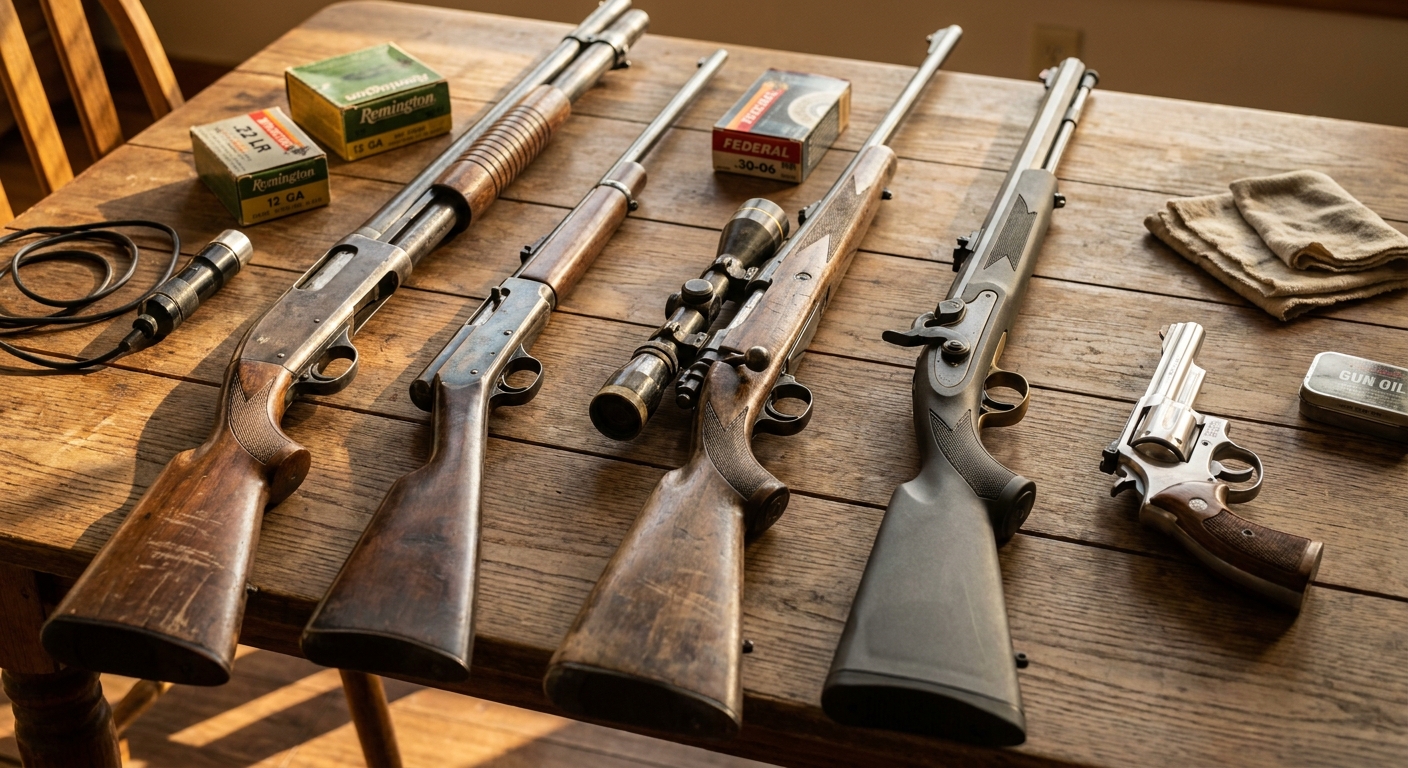
Most hunting households accumulate firearms the way gear piles up in the garage—reactively, seasonally, whenever a new opportunity or marketing push creates urgency. A shotgun for waterfowl season. Another for turkey. A rifle for the deer lease, a second for elk. The safe becomes a museum of single-purpose tools that rarely rotate. Each one sheds value the moment you walk out of the shop.
This sprawl isn't just expensive. It's inefficient, and it often means newer family members or guests arrive empty-handed or borrow mismatched gear that doesn't fit their frame or skill level. Meanwhile, manufacturers encourage the cycle: new models every year, chamberings that fragment your ammunition inventory, proprietary parts that force factory dependency.
A disciplined approach flips the model entirely. Five carefully chosen used firearms, selected for versatility and shareability, can cover every season and game animal a household will encounter—upland birds, waterfowl, small game, big game, muzzleloader seasons, and backup or finishing needs. Well-maintained used rifles can retain up to 90% of their new price, making the used market a value-preservation play rather than a depreciation trap. Classic hunting firearms function as inflation hedges, holding worth across decades when properly maintained. Buying used from the right platforms or private sellers means paying closer to true market value instead of the 50-65% dealer buyback price that erodes new-gun investment the instant you sign the receipt.
This isn't about nostalgia or frugality for its own sake. It's about building a functional, multigenerational battery that prioritizes repairability, ammunition efficiency, and regulatory resilience over marketing cycles and feature creep.
Three Non-Negotiables
Before selecting any model, three criteria must filter every candidate: repairability, cross-platform ammunition compatibility, and non-toxic load availability.
Repairability means choosing platforms with deep parts availability, simple mechanical designs, and widespread gunsmith familiarity—guns that can be serviced in any town, not just returned to the factory. The Remington 700 exemplifies this standard with parts from suppliers like Numrich Gun Parts Corp, MidwayUSA, and EABCO covering bolts, triggers, barrels, and receivers.
Cross-platform ammunition compatibility ensures the household stocks fewer calibers and gauges—reducing costs, simplifying logistics, and preventing the nightmare of discovering you're out of one chambering when another shelf is full.
Non-toxic load availability is regulatory future-proofing. Federal law already mandates approved non-toxic shot for waterfowl hunting nationwide and for shotgun hunting on wildlife refuges and waterfowl production areas. California fully implemented a complete ban on lead ammunition for all hunting purposes statewide on July 1, 2019, signaling the regulatory direction other states may follow. Iowa requires non-lead ammunition for all game animals except deer and turkey on selected public hunting areas in the north-central and northwest regions, showing how regulations can be patchwork and location-specific. Arizona, Utah, Oregon, New York, and Wyoming offer free or discounted lead-free ammunition programs, particularly in California condor ranges and areas with eagle conservation concerns. For the 2026-2027 season, the U.S. Fish & Wildlife Service offers lead-free ammunition incentives at 26 refuges across 19 states, providing up to $50 per rifle box and $25 per shotgun box.
Choosing firearms and chamberings with robust non-toxic options today means the battery remains compliant regardless of where regulations move tomorrow.
Slot One: The Pump Shotgun
Slot one demands a pump-action shotgun in 12 gauge with interchangeable chokes, a chamber length of 3 inches minimum, and a barrel length versatile enough for both marsh and upland cover—typically 26 to 28 inches. The platform must be proof-tested for steel shot and compatible with modern non-toxic loads like bismuth, tungsten, and steel. This rules out many vintage shotguns with older barrel metallurgy.
The Remington Model 870 is the best-selling shotgun in history with over 11 million units built since 1951, designed for high reliability with modern construction that is easy to disassemble and maintain. Its ubiquity ensures parts are available at every gun show, online supplier, and local shop—you can rebuild one from the ground up without waiting on proprietary components.
Look for used 870 Wingmaster or Express models with 3-inch chambers, RemChoke threading, and minimal finish wear—these can be found for a fraction of new price and refurbished with basic tools. Alternative candidates include the Mossberg 500/590 series and the Winchester SXP, both of which offer similar parts availability and used-market depth.
This single shotgun covers dove, quail, pheasant, duck, and goose—with the right choke tubes and non-toxic loads, it eliminates the need for separate upland and waterfowl guns.
Slot Two: The Rimfire Trainer
Slot two is the rimfire trainer and small-game workhorse—a.22 LR that introduces new shooters to fundamentals, fills squirrel and rabbit tags, and gets used more than any other gun in the battery. The ideal platform is semi-automatic for ease of use, has adjustable length of pull or modular stocks to fit multiple users, and features iron sights plus optic-mounting capability.
The Ruger 10/22 has over 8 million units produced as of 2020, with estimates suggesting around 9 million by 2024, making it America's most popular.22 rifle in continuous production since 1964. A complete 10/22 can be built without any Ruger-made components due to the vast aftermarket, with hundreds of third-party manufacturers offering triggers, barrels, magazines, and stocks. That depth means a used 10/22 can be incrementally upgraded as budget allows—new trigger groups, match barrels, youth stocks—without replacing the entire platform.
Look for used carbines or compact models with factory iron sights and clean bores—avoid heavily modified examples unless the work was done by a reputable gunsmith, as amateur upgrades often introduce reliability issues. Takedown models add portability for pack-in hunts and easy storage, and the used market has flooded with early takedown versions as owners chase newer iterations.
This rifle teaches trigger control, sight picture, and shot discipline to every new hunter in the family—and it pays for itself in small-game meat and reduced ammunition costs compared to centerfire practice.
Slot Three: The Centerfire Rifle
Slot three is the centerfire big-game rifle—a bolt-action platform chambered in a caliber that balances recoil for smaller-framed or newer shooters with terminal performance on deer, elk, and everything in between. The chambering should prioritize ammunition availability in both lead and non-toxic (copper, gilding metal) bullet offerings—.308 Winchester and.30-06 Springfield lead this category, with.270 Winchester and 6.5 Creedmoor as viable alternatives.
The Remington 700 is the ideal platform here. Its aftermarket rivals the 10/22 in depth—stocks, triggers, barrels, and bottom metal are available from dozens of manufacturers, allowing incremental upgrades and repairs without factory dependency. Look for used ADL, BDL, or SPS models in.308 Winchester or.30-06 with standard-length actions, clean bores, and original stocks—these can be found for half the price of new equivalents and refurbished with drop-in parts. Alternative platforms include the Savage 110 series, Ruger American, and Winchester Model 70, all of which offer strong used-market presence and parts support.
Non-toxic bullet options from Barnes, Hornady, Federal, and Nosler are now widely available in.308 and.30-06, ensuring compliance with California's statewide lead ban and other emerging regulations without sacrificing terminal performance. This rifle covers deer, black bear, pronghorn, and elk with proper bullet selection—and with a quality scope and sling, it becomes the family's go-to for any big-game tag drawn or purchased.
Slot Four: The Muzzleloader
Slot four unlocks extended or primitive-weapon seasons in nearly every state, often during premium rut periods or less-crowded windows when modern firearms are prohibited. The ideal used muzzleloader prioritizes ignition reliability (inline percussion or modern primer ignition), ease of cleaning, and compatibility with saboted copper or polymer-tipped non-lead projectiles.
Inline muzzleloaders like the CVA Optima, Thompson/Center Triumph, or Traditions Pursuit offer simple disassembly, weatherproof ignition systems, and widespread parts availability in the used market. Look for used inlines with stainless or Cerakote finishes for corrosion resistance, fiber-optic sights, and 1:28 or faster twist rates to stabilize modern saboted bullets—these features ensure compatibility with non-toxic projectiles and all-weather reliability.
Avoid heavily used muzzleloaders with pitted bores or cracked stocks—unlike centerfires, muzzleloader barrels are harder to replace and corrosion from black powder or substitute propellants degrades accuracy quickly. Non-toxic saboted bullets from Barnes, Hornady, and PowerBelt are standard offerings, ensuring compliance with lead-free regulations while delivering consistent terminal performance on deer-sized game.
This firearm may see the least annual use in the battery, but it opens calendar windows and tag opportunities that justify its place—especially in states with dedicated muzzleloader deer, elk, or pronghorn seasons.
Slot Five: The Handgun
Slot five is the sidearm—for finishing wounded game, backup protection in bear or hog country, and occasionally as a primary tool for handgun-only seasons or close-quarters hunting. The ideal platform is a double-action revolver or simple striker-fired semi-automatic in.357 Magnum/.38 Special,.44 Magnum/.44 Special, or 10mm Auto—calibers offering scalable power and widespread ammunition availability.
Revolvers excel in this role due to mechanical simplicity, ease of cleaning, and the ability to chamber multiple power levels in the same cylinder—.38 Special for practice,.357 Magnum for game. Look for used Ruger GP100, Smith & Wesson Model 686, or Ruger Redhawk models with 4- to 6-inch barrels, adjustable sights, and stainless finishes—these platforms are nearly indestructible.
For semi-auto buyers, the Glock 20 (10mm) or Glock 40 MOS offer striker-fired reliability, aftermarket support, and compatibility with hard-cast or monolithic copper bullets suitable for both non-toxic regulations and dangerous game backup. Avoid used handguns with timing issues (revolvers) or aftermarket trigger jobs (semi-autos) unless performed by reputable gunsmiths—these are the most common sources of reliability failures in the field.
This handgun may spend most of its time on the hip rather than in hand, but when a deer goes down in thick cover or a hog charges from close range, it earns its place in the battery instantly.
Sourcing and Maintenance
Building this battery begins with sourcing—online marketplaces like GunBroker and local gun shows offer volume and price discovery, while private sales and estate liquidations often yield the best deals on well-maintained firearms. Buying directly from private sellers or consignment racks means paying closer to true market value and avoiding the dealer spread.
Inspect every used firearm in person when possible—check bore condition with a flashlight, test action smoothness, verify mechanical timing (revolvers) or headspace (rifles), and examine stocks and metal for cracks or serious corrosion. Budget 10-20% of the purchase price for refurbishment—new springs, a professional cleaning, stock refinishing, or sight replacement can transform a tired gun into a strong performer without the depreciation hit of buying new.
Resist the temptation to chase trends or over-customize—firearms without modifications retain more value. Keep original parts, document any upgrades, and prioritize function over fashion. Establish a maintenance rhythm: clean and inspect each firearm after every season, replace springs and wear parts on a schedule rather than when they fail, and store the battery in a climate-controlled safe with desiccant to prevent corrosion.
This five-gun battery isn't a static collection—it's a working system that grows more valuable as ammunition regulations tighten, as younger family members learn on proven platforms, and as decades of reliable service prove the wisdom of disciplined, sustainable ownership over reactive accumulation.