Guides
Buy Once, Fix Forever: Building a Lifetime Gunsmithing Tool Kit for Under $500
By Staff · July 21, 2026
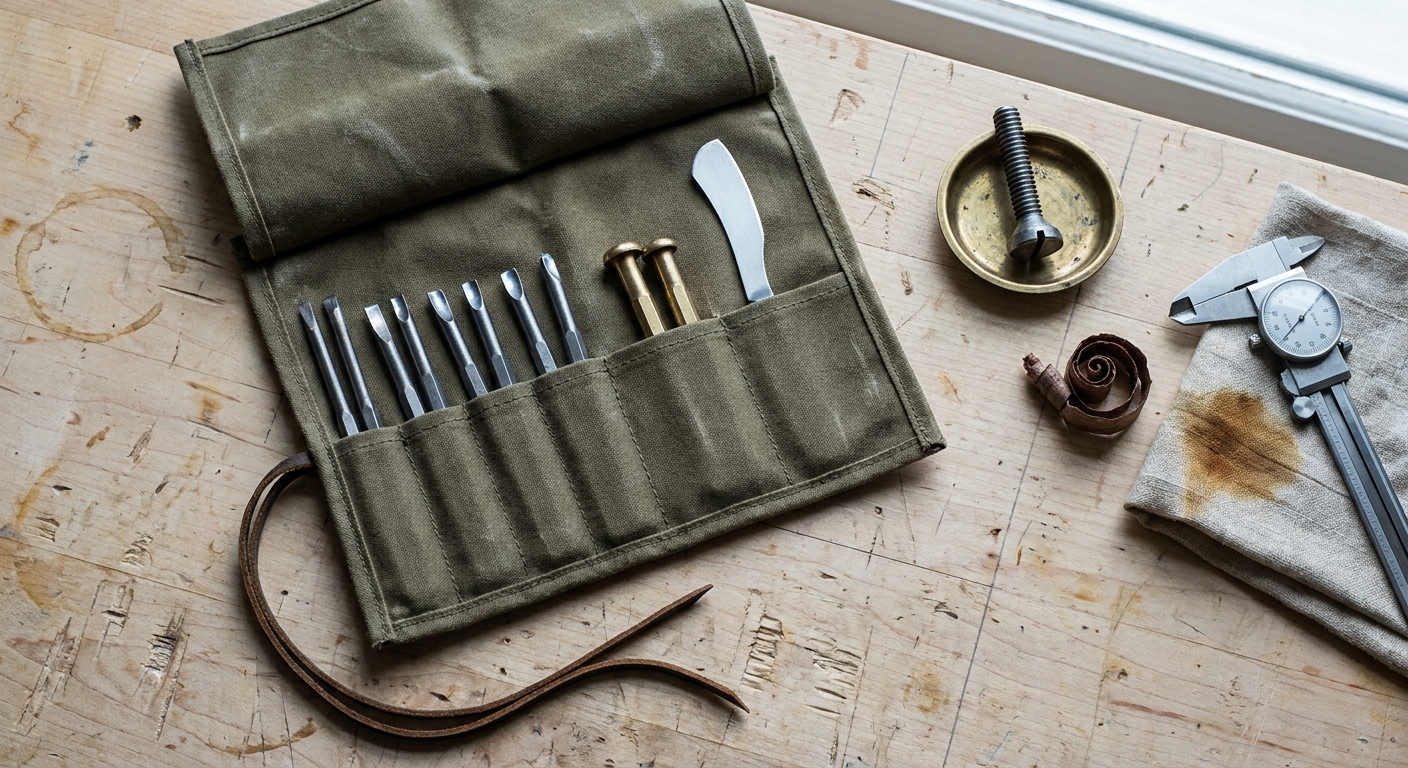
A pre-war Colt can survive a century of use and still be damaged in seconds by the wrong screwdriver. Heritage firearms often use unique, nonstandard screws that are no longer manufactured, and damaging them can require costly custom fabrication or compromise the firearm's value permanently. With most gunsmith shops charging $75 to $100 an hour for general labor and $100 to $125 an hour for machining or specialty work, a single stripped screw head or gouged walnut stock can cost more to repair professionally than the entire $500 toolkit described here. The investment is not about being cheap—it is about buying the right tools once to prevent butchering what cannot be replaced.
Hollow-Ground Screwdrivers: Buy These First
This is where "making do" most often turns a sound old gun into a damaged one.
Gun screws are cut with parallel sides, not tapered, and hollow-ground screwdriver bits have a concave tip that creates parallel faces matching this geometry perfectly. Standard tapered screwdrivers contact only the top edges of the screw slot, concentrating pressure on small areas that cause deformation, while hollow-ground bits engage the entire surface from top to bottom with evenly distributed force. Industry consensus from gunsmithing sources holds that using a standard screwdriver on a heritage firearm is a recipe for disaster because the tapered blade inevitably cams out and ruins the slot.
For a budget-conscious foundation, the Chapman #8900 screwdriver set costs $47 to $49; the Wheeler 43-piece gunsmithing screwdriver set runs $49.99; and the Brownells Magna-Tip 22-bit starter set comes in at $89.99 to $94.99 with a lifetime handle system for those who plan to expand. A $40 to $90 investment in the right sizes covers 90% of American and European heritage firearms and prevents irreversible screw-slot damage that would cost hundreds to repair.
Punches and Hammer
Buy a complete punch kit: steel pin punches for removing tight pins, brass drift punches for non-marring sight adjustment and delicate work, and roll-pin punches with a drilled center that holds roll pins without flaring them. Steel punches provide the hardness needed for tight pins; brass punches are soft enough to avoid marring finishes, with any marks removable with steel wool. Professional gunsmiths recommend buying a full set rather than individual punches, as using the wrong size can flare pin heads and ruin the firearm surface—common sizes include 1/8", 9/64", 5/32", 3/16", 7/32", 1/4", 9/32", and 5/16". A nylon or brass hammer completes the kit by delivering controlled strikes without the damage a standard steel hammer would inflict on century-old receivers and pins.
Headspace Gauges: Knowing When to Stop
Headspace gauges serve a different purpose than the tools above. They do not give the owner permission to force a repair. They mark the point where the owner stops.
Three types serve different functions: GO gauges check minimum chamber dimension to ensure SAAMI-max ammunition fits safely; NO-GO gauges confirm the chamber does not exceed the recommended maximum for new chambering; and FIELD gauges identify if headspace exceeds the maximum safe limit. If a firearm's action closes on a FIELD gauge, headspace is excessive and the gun is unsafe to fire. These gauges are essential for any work involving chamber reaming, barrel replacement, or action fitting, and for evaluating surplus military rifles, reloaded ammunition, or inherited firearms of unknown provenance.
Prioritize gauges for common cartridges:.223 Remington/5.56mm NATO,.308 Winchester/7.62mm NATO,.30-06 Springfield,.22 LR, and belted magnums like.300 Winchester Magnum. A GO/NO-GO set for a single caliber costs $50 to $100. If a firearm fails a headspace check or requires chamber work, that is the line between home maintenance and professional gunsmith territory.
Stock Work: Restraint as Skill
The owner trying to preserve an old stock is fighting the urge to "improve" away the very details that make it worth keeping.
For walnut gunstock work, essential tools include the #49 Cabinet Maker's Rasp for rough shaping, precision inletting scrapers for detail work, gouges and chisels for additional detailing, and files for smoothing before finishing. Scrapers and rasps remove wood in controlled layers without tearing grain, while cheap sandpaper tears fibers and destroys the crispness of original checkering and inletting that define a heritage stock's value. A modest investment in a #49 rasp, a set of precision scrapers, and appropriate finishing oils lets you refresh dried or damaged wood, remove minor dings, and re-oil stocks without obliterating the patina or hand-cut details that make heirloom walnut irreplaceable. If a stock has intact original checkering, figured grain, or factory inletting, your job is preservation and oil, not reshaping.
The Budget Breakdown
The $300 Core covers routine disassembly, cleaning, screw removal, pin work, and minor stock maintenance on the vast majority of American revolvers, shotguns, and rifles from the 1890s through the 1970s:
- Hollow-ground screwdriver set: $50–$90
- Full set of steel, brass, and roll-pin punches: $60–$90 combined
- Nylon or brass hammer: $15–$25
- Basic calipers and feeler gauges: $30–$50
- Stock scrapers and oils: $40–$60
The $200 Specialist Layer adds capability for safety verification and precision work:
- Headspace gauges for your most-shot calibers: $50–$100 per caliber set
- Precision files for trigger and sear work: $40–$60
- Quality gunsmithing vise or padded clamp: $50–$80
Where to save: skip electric tools, cheap multi-bit sets that include tapered screwdrivers, specialty wrenches for guns you do not own, and measurement tools beyond calipers and feeler gauges unless you are doing chamber work. Where not to save: never buy tapered screwdrivers for slotted gun screws, never substitute a steel punch where brass is called for, and never use a standard hammer on pins—these are the shortcuts that turn maintainers into parts-breakers.
The Lifetime Return
Over a lifetime of maintaining heritage firearms, this $500 investment pays for itself within five to ten shop visits while preventing the irreversible damage that comes from using the wrong tool on irreplaceable parts. Owning the right tools means you do not turn a functional Winchester into a safe queen because you lack a hollow-ground bit, and you do not butcher heirloom walnut because you reached for sandpaper instead of a scraper. The lifetime value is not just financial—it is the ability to pass both guns and the craft of maintaining them to the next generation, ensuring that heritage firearms remain working tools rather than museum pieces.