Guides
Chamber-Insert Adapters: How a $30 Sleeve Can Bring a Forgotten Caliber Back to the Field
By Staff · July 4, 2026
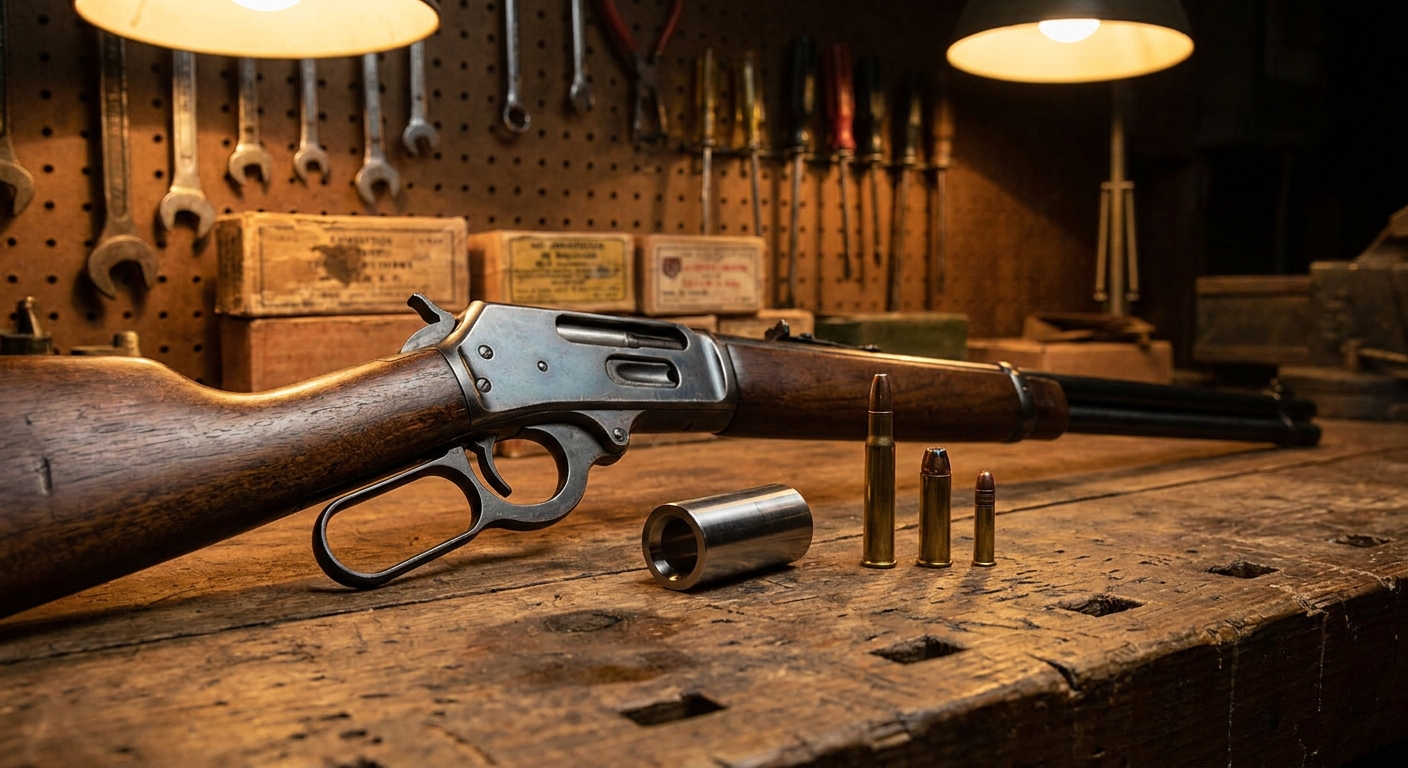
Your grandfather's.348 Winchester lever-action hasn't been fired in twenty years. Not because it's broken—because ammunition runs several dollars per round when you can find it, and California won't let you hunt with lead anymore. The rifle works. The market doesn't. A machined steel sleeve the size of your thumb can change that.
Many shooters inherit rifles chambered in cartridges no longer widely manufactured—rounds like.25-20 Winchester,.32-20 Winchester,.38-40 Winchester,.250 Savage,.300 Savage,.348 Winchester,.30-40 Krag, and.284 Winchester. Some calibers became instantly obsolete when their host firearms were discontinued: the.348 Winchester was designed exclusively for the Winchester Model 71 lever action.
Specialized manufacturers like Steinel Ammo Co., Old South Ammo, and Buffalo Arms fill the gap, but their ammunition is expensive and typically available only in traditional lead projectiles. Meanwhile, California mandates non-lead ammunition for all hunting to protect California condors, and a 1991 federal ban already prohibited lead shot for waterfowl hunting. For owners of obsolete-caliber rifles, this creates a double bind: expensive, hard-to-find ammunition that often doesn't meet modern conservation requirements.
Chamber inserts offer a way out.
How They Work
A chamber insert is a metal adapter inserted into a firearm's chamber to allow it to fire a shorter or different cartridge than originally designed, typically by matching the base diameter while altering cartridge length or diameter. The execution varies. For shorter cartridges of similar base diameter, the insert resembles the front of a cartridge case and remains in place until removed with a stuck-case tool. For altering cartridge diameter, supplemental chambers are loaded and ejected as a unit with the smaller round inside. The adapter's sleeve is often rifled to engage the bullet and stabilize it in flight, compensating for the diameter mismatch between the smaller bullet and larger bore. If the adapter uses a rimfire cartridge like.22 LR, it must include a special offset firing pin that crushes the rim when struck by the firearm's centerfire pin.
Harry Owen of Sport Specialties historically created over 400 types of chamber adapters and insert barrels, demonstrating the breadth and maturity of this technology.
Common conversions include.30-caliber rifles to.32 handgun rounds and.35-caliber rifles to.38 handgun rounds. By converting to a common cartridge like.32 ACP or.38 Special, shooters gain access to widely available lead-free ammunition—monolithic copper, bismuth, steel, zinc, tin, and composite bullets—that would never be manufactured for their original chambering. Monolithic copper bullets in particular offer excellent weight retention, deep penetration, and controlled expansion suitable for deer, elk, and bear hunting.
The Technical Compromises
The question is whether these compromises make chamber inserts a practical solution or a dangerous shortcut.
Adapters often lack the tight gas seal of brass casings, leading to powder fouling, louder reports, and gas leakage. They cause reduced velocity due to inefficient powder burn, and accuracy drops significantly at distance compared to a proper barrel chambered for the cartridge—especially if the bullet diameter is significantly smaller than the rifle bore, even with rifled adapter sleeves. Some adapters have developed cracks around the shoulder and base, indicating potential structural weakness that users should inspect for before each use.
The safety risks sharpen with the wrong platform. Subcaliber inserts are generally safe in break-action shotguns and manually operated actions when converting to lower-pressure cartridges, but they carry significant risks in semi-automatic rifles. In semi-automatics like the AK-47, adapters can cause partial cycling, leading to frequent jams or accidental full-auto fire if the trigger is held.
The appropriate use case is break-action firearms, single-shot rifles, and lever actions used for short-range hunting or practice within 50–75 yards—not semi-automatics, not precision long-range work, and not with cartridges exceeding the insert's pressure rating.
The Conservation Case
The stakes are real. Research shows that 88 fragments of lead can be embedded in gut piles and carcasses, and 32 species of scavengers are at risk from lead poisoning when they consume these remains. For obsolete-caliber rifles, lead-free ammunition is often completely unavailable—the market is too small to justify developing multiple bullet types.
Chamber inserts provide the only practical path for these firearms to comply with lead-free mandates by converting to common cartridges where copper and alternative projectiles are widely manufactured. This transforms an obsolete-caliber rifle from a conservation liability into a tool compatible with modern land stewardship.
Before You Buy
Match the insert to your bore diameter and choose a common cartridge with the right base diameter—.30-caliber rifles pair with.32 handgun rounds,.35-caliber rifles with.38 handgun rounds. Avoid semi-automatic platforms entirely. Inspect adapters for cracks around the shoulder and base before each use. For inserts that remain in the chamber, keep a stuck-case removal tool on hand; for supplemental chamber adapters, the adapter loads and extracts as a unit with the fired cartridge inside. Expect more frequent cleaning due to the adapter's imperfect gas seal, and limit use to short-range applications where the accuracy and velocity penalties are manageable.
Heritage and Stewardship
Chamber inserts represent a rejection of planned obsolescence—the principle that a well-made firearm doesn't become worthless just because its original ammunition fell out of commercial favor. Owen's 400-plus adapter designs reflect a craft tradition of keeping tools functional across generations. By enabling lead-free shooting in firearms that would otherwise have no non-toxic option, they let hunters honor both the heirloom and the land—refusing to choose between family heritage and ecological responsibility. That's the maker's ethic: understanding the technical constraints, accepting the limitations, and taking ownership of both the tool's continued service and its impact on the ground you hunt.
A $30 chamber insert transforms the equation from waste versus harm into active, responsible use that serves both memory and stewardship.