Guides
Proof Before Polish: The Safety Inspection Every Old Gun Deserves Before Restoration
By Staff · July 13, 2026
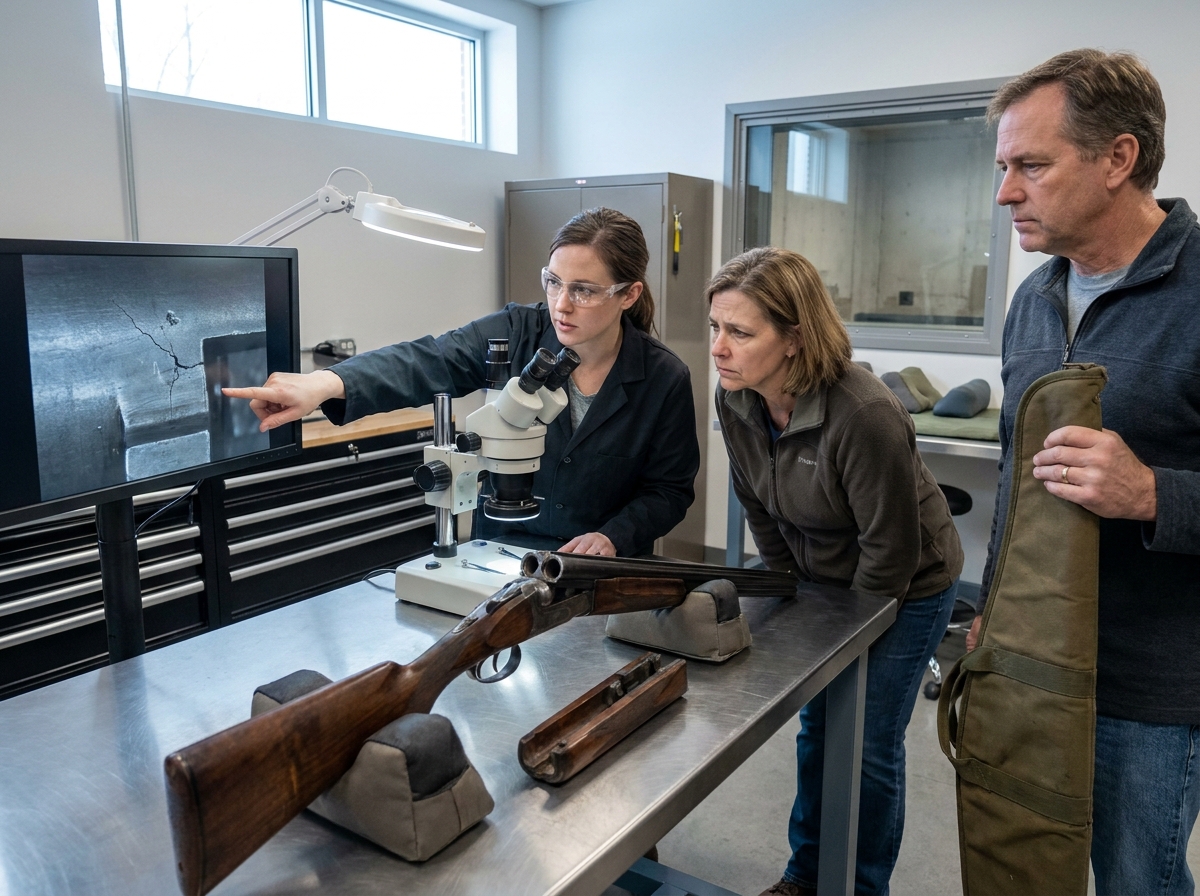
An inherited deer rifle can sit for decades with a dull bore, rust freckles and a stock begging for sandpaper. An estate-sale revolver can look like a weekend restoration waiting to happen. But the first tool it needs is not steel wool, cold blue or refinishing oil. It is a safety inspection.
Before anyone makes an old gun look cared for, someone qualified needs to determine whether it can safely contain firing pressure. A family connection, collector appeal or handsome finish cannot make a compromised firearm sound. Hidden cracks, deep corrosion, amateur alterations and oil-soaked wood can turn an old gun into a serious hazard. Polishing a firearm before establishing that it is safe to fire is not stewardship. It is vanity with a better finish. That is the rule: proof before polish.
The inspection starts with the simplest concern. Verify the chamber is empty, then inspect the bore for obstructions. Grease, dirt or a stuck bullet can create dangerous back pressure, potentially splitting a barrel or shattering a bolt. If a cleaning patch or jag will not clear the obstruction, consult a gunsmith to avoid damaging the barrel.
Only after the bore is clear does the real pre-restoration audit begin: headspace, lockup, chamber dimensions, bore condition and the structural problems that old finish can conceal. This sequence determines whether restoration is even possible, or whether the firearm's working life has safely ended.
For rifles and other closed-bolt actions, headspace checking is the most critical safety inspection in gunsmithing, verifying that a firearm's chamber dimensions are within safe limits to prevent catastrophic case failures. Before testing, a gunsmith must unload the firearm, disassemble the action to remove the extractor, ejector and firing-pin assembly, clean the chamber to remove dirt and rust, and cycle the action to understand normal closing force.
Proper headspace is tested with precision GO, NO-GO and sometimes FIELD gauges. The bolt must rotate into full battery without resistance on the GO gauge; if it does not close, the headspace is too tight. On the NO-GO gauge, the gunsmith should feel resistance or a hard stop before the bolt reaches full battery. If the bolt closes completely on the NO-GO gauge, the headspace is excessive and the gun is unsafe to fire until repaired by a competent gunsmith. A FIELD gauge can then determine whether the issue is minor wear or critical failure; if the bolt closes on the FIELD gauge, headspace exceeds the maximum allowed for safe firing and the gun must be immediately removed from service. Gunsmiths must never force the action during headspace checking—operating with only one finger if possible—because forcing a bolt closed can damage the gauge or the firearm and produce inaccurate readings.
For revolvers, the inspection shifts to cylinder lockup and timing: the cylinder chamber must align precisely with the barrel forcing cone just as the bolt locks into the cylinder notch.
In the fast cocking test, pull the hammer back quickly twelve times and try to rotate the cylinder by hand at the end of each pull. With proper timing, you should hear no click and feel no play. If you must twist the cylinder to the left to hear a click, the cylinder has rotated past the lock point. If you must twist to the right, the cylinder has not rotated far enough to align.
Check lockup with the hammer fully cocked by gently trying to wiggle the cylinder side-to-side, up-and-down and rotationally. There should be minimal to no movement; excessive play indicates timing issues or worn components. If a revolver is out of time, the bullet may strike the barrel-cylinder junction, creating potential for explosion. Fixing timing issues often requires replacing the hand—the component that rotates the cylinder—or adjusting the bolt stop, work that requires skill and precision.
Bore condition inspection must identify corrosion and pitting that indicate metal stress, erosion that affects pressure dynamics, scoring and stripping as critical failure points, and frosting indicating a worn-out bore. If the barrel is compromised by pitting or obstruction, expanding gases can escape backward through the action, turning the firearm into a grenade.
Rust creates shallow pits in non-stainless steel that weaken the metal surface. Deep pits can act as stress points for cracks, causing reduced barrel integrity leading to potential rupture under firing pressure. Cracks often form due to heat, fatigue or poor maintenance and may be longitudinal—along the barrel—or circumferential, wrapping around. Such cracks can lead to barrel failure, causing high-pressure gas and metal fragments to explode outward. Improper repairs such as mismatched cylinder-barrel alignment in revolvers prevent parts from locking securely, resulting in shrapnel if the cylinder and barrel do not line up correctly when locked.
Because many defects are hidden, visual inspection alone is often insufficient. Professional techniques include a borescope or an inspection camera to examine rifling, chamber and bore for fissures and chromium plating removal invisible to the naked eye; dye penetrant testing using ultraviolet light to reveal cracks; and ultrasonic testing to detect deeper, hidden flaws.
If any signs of cracking, deep pitting or structural fatigue are found, the firearm should be deemed unsafe until evaluated by a professional gunsmith. Cracked barrels should generally be replaced entirely because repairs rarely restore the structural integrity needed for safe firing.
Cracks and stress fractures in gunstock wood are not cosmetic flaws. They are structural failures caused by recoil forces, often exacerbated by gun oil saturation that weakens wood fibers and prevents adhesives from bonding properly. Cracks near the receiver tang or wrist are critical stress points and often require bedding the action to redistribute recoil stress.
If a stock crack shifts under pressure, the wood has lost integrity and the gun should not be fired until reinforced with doweling or pinning and proper bedding. Oil saturation prevents glue adhesion; wood must be immersed in solvent such as turpentine or white spirits for six to twelve cycles to remove oil before repair. If the crack is in the wrist and the wood is compromised, firing the gun could cause the stock to shatter under recoil, potentially injuring the shooter. In such cases, professional restocking may be safer than repair.
After the safety inspection is complete, the gunsmith weighs the findings to render one of three verdicts.
The first: safe to shoot as-is, meaning the firearm passed all critical inspections—headspace within spec, bore sound, lockup tight, no hidden cracks, stock solid—and can be restored cosmetically and returned to service.
The second: safe after specific repairs, meaning the firearm has repairable issues—excessive headspace that can be corrected, a cracked stock that can be properly reinforced and bedded, worn timing that can be adjusted with a new hand—and the repairs are economically and technically feasible.
The third: retired to the wall, meaning the firearm has structural damage that cannot be safely repaired—a cracked barrel, corroded action, bulged chamber or metal fatigue that makes firing a catastrophic risk. Restoring such a firearm cosmetically could create a hidden risk of accidental discharge or catastrophic failure. For guns with cracked or bulged barrels, permanently block the chamber by filling it with lead or welding it and display the firearm as inert. For severe corrosion weakening metal or damaged firing pins or sears that cannot be replaced, block the chamber permanently and display the firearm without restoration.
That final verdict is not defeat but an act of respect, acknowledging that the firearm gave its working life and deserves to rest safely rather than risk catastrophic failure.
A gun earns its place in the safe only if it can still do the job it was built for, safely. Cosmetic restoration without structural verification creates a dangerous illusion that a firearm is ready for work when the metal and mechanisms may be one trigger pull from failure. And the most respectful restoration is sometimes no restoration at all—rendering the gun permanently inert and displaying it as a piece of history, not a working tool. Honoring a firearm's working heritage means ensuring it can still work safely, and when that is no longer possible, honoring it means letting it rest.