Stewardship
Obsolete Does Not Mean Disposable: How Makers Reproduce Unavailable Parts for Old Firearms
By Staff · July 13, 2026
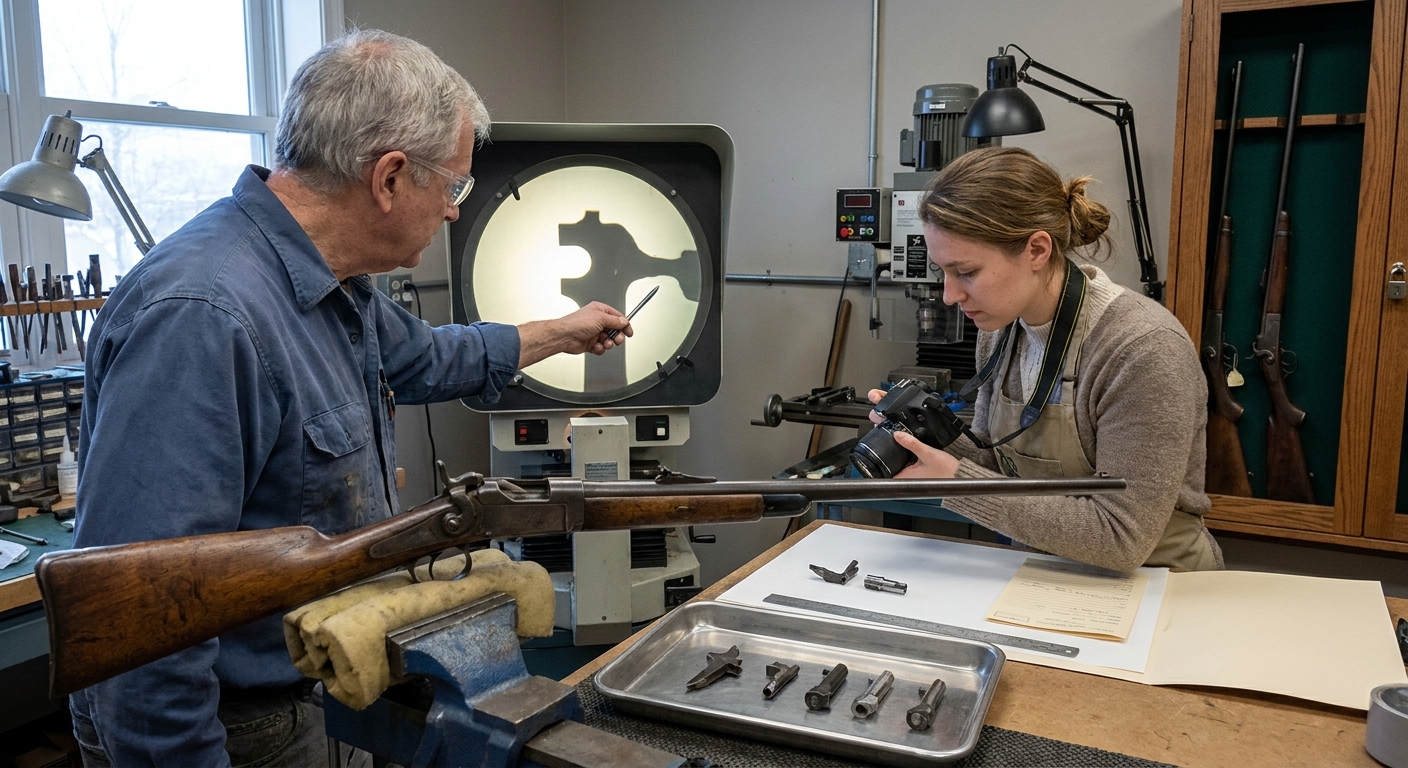
A single failed part can turn a sound inherited firearm into a wall-hanger: a chipped firing pin, a broken spring or a worn extractor for which the original maker disappeared decades ago and replacements disappeared with it. For the owner, the usual alternatives are grim—retire a serviceable gun or strip another scarce example to keep it running. Reproducing the failed component offers a third route, keeping the repaired firearm in service without reducing another complete gun to a source of parts. This is heritage gunsmithing meeting modern fabrication, with careful measurement, informed material choices and hand-fitting replacing the sacrifice of original guns.
The work begins with a blunt fact. Many antique firearms outlived their factory drawings, parts lists and engineering specifications, making reverse engineering the only way to reconstruct design intent. The job is not simply copying a broken object. It is working out what the original maker intended, understanding what the part does inside the action, and accounting for the wear accumulated by the particular gun on the bench. A part that looks right but does not function safely is not a successful reproduction.
Calipers and micrometers still earn their keep, but hand measurements fail to accurately capture the compound curves, angles and intricate profiles found in firearm components. Gunsmiths reproducing obsolete parts commonly use 3D laser scanning, accurate to about 0.0015 inch, to capture outside surfaces, while industrial CT scanning can reveal internal slots, passages and assemblies without disassembly. That precision is not academic. Firearm tolerances can sit at the edge of manufacturing capability, where 0.0015 inch or 0.001 millimeter may separate a workable component from a dangerous one.
The reverse engineering workflow moves from data capture through laser or CT scanning, to digital modeling in CAD software such as Geomagic or SolidWorks to create parametric models, to validation using accuracy analyzers that compare CAD models back to original scan files, and finally to documentation generating 2D manufacturing drawings with optimized tolerances. The objective is not necessarily a museum-perfect duplicate. The process often involves updating old designs with modern tolerances or materials while preserving original function. Respect the design, but do not make the gun's survival depend on obsolete production methods.
Dimensions are only half the job. Material selection carries equal weight and separates qualified work from wishful thinking. For many firearm components, 4140 and 4150 chrome-molybdenum steels provide a practical mix of toughness, hardenability and machinability under repeated high-pressure stress. Gun parts must handle abrupt, variable loads—including the pressure spike of firing—not merely hold up under a steady static load.
For high-stress structural components needing greater impact toughness, 4340 steel is specified; under AMS 6415, it is described as 50 percent stronger than 9310 and as having superior impact toughness. Case-hardening steels such as 8620 and 9310 are used for bolt carriers and firing pins when the part needs a hard skin over a more ductile core. Triggers and sears often call for 4140 or O-1 tool steel hardened beyond 50 HRC so their sliding contact surfaces resist wear.
Then comes heat treatment, which determines whether a well-machined part becomes durable or dangerously brittle. The process relies on annealing to relieve machining stress, quenching—often in oil or transmission fluid—to lock in strength, and tempering to toughen the steel, with tempering arguably the most vital step for preventing brittleness. Critical pressure-bearing components like barrels and bolts typically undergo quenching followed by tempering to achieve a final Rockwell hardness of 26 to 32 HRC for rifle barrels and approximately 40 HRC for pistol barrels. High-carbon steels like 1050 can be heat-treated to nearly 60 HRC but must be tempered to approximately 40 HRC to avoid excessive brittleness. Surface treatments including gas nitriding and nitrocarburizing processes such as Melonite can raise surface hardness to 2,000 HV while improving corrosion resistance and limiting distortion.
With the design and steel settled, precision CNC equipment can machine firearm parts from aluminum, steel or titanium stock to tolerances as tight as 0.0001 inch. That does not make CNC a substitute for judgment. CNC machining cannot account for decades of wear, deformation or factory variation in obsolete firearms, which often need individual adjustment to fit specific legacy actions.
That adjustment is hand-fitting—the point where a promising blank becomes a working component. Filing and stoning ensure the new part interfaces correctly with the old firearm, adjusting CNC-machined dimensions to match the specific gun's unique wear patterns. No single vendor universally offers obsolete-parts fabrication as a standard package because the work requires a specialized combination of reverse engineering, precision machining and manual fitting.
The tools and workflows of parts reproduction—3D laser scanning, industrial CT, parametric CAD modeling and CNC machining—place heritage gunsmithing squarely within the broader maker movement's embrace of digital fabrication. Software like Geomagic, Rapidform XOR or SolidWorks converts scan mesh data into parametric CAD models, creating an editable digital twin with feature trees for future modifications. Hot isostatic pressing is used for additive-manufactured components to close voids and eliminate weakness, achieving hardness and strength similar to extreme-duty materials like 4340.
Yet craft judgment remains non-negotiable. A CAD model cannot choose the right steel. A CNC program cannot decide how a part should be heat-treated or where it must be stoned for proper fit. For components exposed to firing stress, locking forces or safety-related engagement surfaces, that judgment separates a technically impressive copy from a component that belongs in a functioning firearm.
Cannibalizing vintage firearms—removing scarce parts from one gun to repair another—remains common but ethically debated in the collector community. Some argue it preserves functional firearms by sacrificing non-repairable parts guns; others believe it depletes the already scarce supply of complete vintage weapons. The practice is generally considered acceptable when the source gun is nonfunctional, incomplete or sold for under $100, and parts are needed to restore a more valuable or historically significant firearm. The market encourages it: individual triggers and safeties may be worth $25 to $30 at online auction, making stripped guns more valuable as parts than as a whole.
That logic is understandable. It is also why reproduction matters. No complete gun is sacrificed, no functional firearm becomes a wall-hanger, and the work can be repeated when the next example needs the same part. Once the measuring, modeling and setup work is finished, small batches begin to make economic sense. Because machinists must tool back up for each job, the cost per unit drops if you order multiple copies—ordering three of the same part is often recommended to save on future failures.
It is not a cheap path, especially for a true one-off. Hall Precision offers one-off reproduction services for obsolete firearm parts at $100 per hour, with a one-hour minimum. McNeil Industries and Mitotec Precision are custom precision machinists that handle low-volume, high-tolerance fabrication of firearms' metal parts. Owners of rare guns report spending $2,000 to $5,000 total on spare parts kits over time.
Before commissioning a one-off, check the established obsolete-parts market. Old Arms of Idaho, CFN Parts, Lee's Gun Parts in Texas and Jack First Gunshop in South Dakota are dedicated vendors offering used and reproduction parts for obsolete firearms. The Rifle Shoppe and Classic Firearms and Parts manufacture high-quality reproduction parts for antique firearms. Small operators like Bob Knapp in Winchester or Wisners in Washington manufacture specific vintage parts sold via eBay and GunBroker.
If reproduction is necessary, ask questions that reveal whether the fabricator understands more than machining: their measurement methods—laser or CT scanning versus hand tools—material selection and heat treatment protocols, and whether they perform hand-fitting after CNC machining. Most high-volume CNC shops focus on OEM and aftermarket runs up to 25,000 pieces rather than single-piece obsolete reproduction, so seek out gunsmiths or small fabricators who specialize in one-off work.
The accountability point is simple: a critical firearm component is not made safe by looking original or emerging accurately from a machine. Dimensions, metallurgy, heat treatment, fit and legal responsibility all carry consequences. Reverse engineering firearm components for manufacturing requires compliance with Federal Firearms License regulations, specifically an FFL-07 for manufacturing if producing parts for sale. Done with that discipline, reproduction gives owners of unsupported firearms a responsible alternative to the wall-hanger and the parts gun: a way to keep a legitimate working arm—and more of the surviving firearms around it—intact.